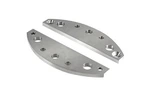
Thin-walled parts are widely used in engineering, with outstanding characteristics such as light weight, high strength and beautiful appearance. According to the spatial geometry, thin-walled parts can usually be divided into two-dimensional thin-walled components represented by slender shafts and three-dimensional thin-walled parts represented by thin-walled parts.
The common feature of such parts is that the force form is complex, the stiffness is low, and it is easy to cause error deformation or workpiece flutter during machining, so as to reduce the machining accuracy of the workpiece.
Especially when the shape and machining accuracy of parts are required to be high, they are very sensitive to vibration, the size and fluctuation of cutting force, cutting temperature and clamping mode. They are often not machined to the specified size, and the parts have exceeded the accuracy requirements. Therefore, the machining and manufacturing of thin-walled parts is extremely difficult, which has become an internationally recognized complex manufacturing process problem.
Through theoretical research and production practice, the following methods can be adopted in actual production to reduce the deformation of aluminum alloy thin-walled parts in high-speed machining:
Vibration aging process. Vibration aging technology can effectively reduce the residual stress by more than 40%, reduce the peak value, homogenize the residual stress, reduce the deformation, meet the dimensional processing requirements, and improve the processing accuracy of parts.
Three auxiliary supports are used for ear shaped thin-walled parts. The error difference between the parts processed with three auxiliary supports and the standard parts is only about 2%, there is no obvious vibration pattern on the surface, and the processing accuracy and surface quality are good; Less than scattered auxiliary support processing surface will produce obvious vibration lines, and more auxiliary support can better suppress the processing vibration of thin-walled parts, but at the same time, it increases the complexity of the fixture and is not economical.
Flexible auxiliary support. The impact force produced by the jet is used to counteract the cutting force produced by the thin-walled parts in the machining process. Improve the process rigidity of parts, reduce the deformation of parts and suppress the vibration of process system. The flexible support will not damage the workpiece, produce indentation and other mechanical damage, and will not map the error of the support part to the workpiece. At the same time, because the jet is used as the medium, the jet itself has the functions of cooling, lubrication, cleaning and rust prevention, while reducing the cutting heat and avoiding the interference of the tool workpiece. However, the flexible auxiliary support needs to have a jet mechanism with jet. In addition, the pressure of jet needs to be determined according to different thickness. These specific parameters need specific calculation, which requires high experience of the operator.
Because of its structural characteristics and technological requirements, the machining of thin-walled parts has become a technical and technical problem of NC milling. High speed machining with small feed rate and large cutting speed is the main processing method to solve the problem of thin-walled parts at present, supplemented by effective processing auxiliary measures, in order to better control the processing deformation, ensure the cutting quality, and meet the corresponding technical requirements of NC milling.